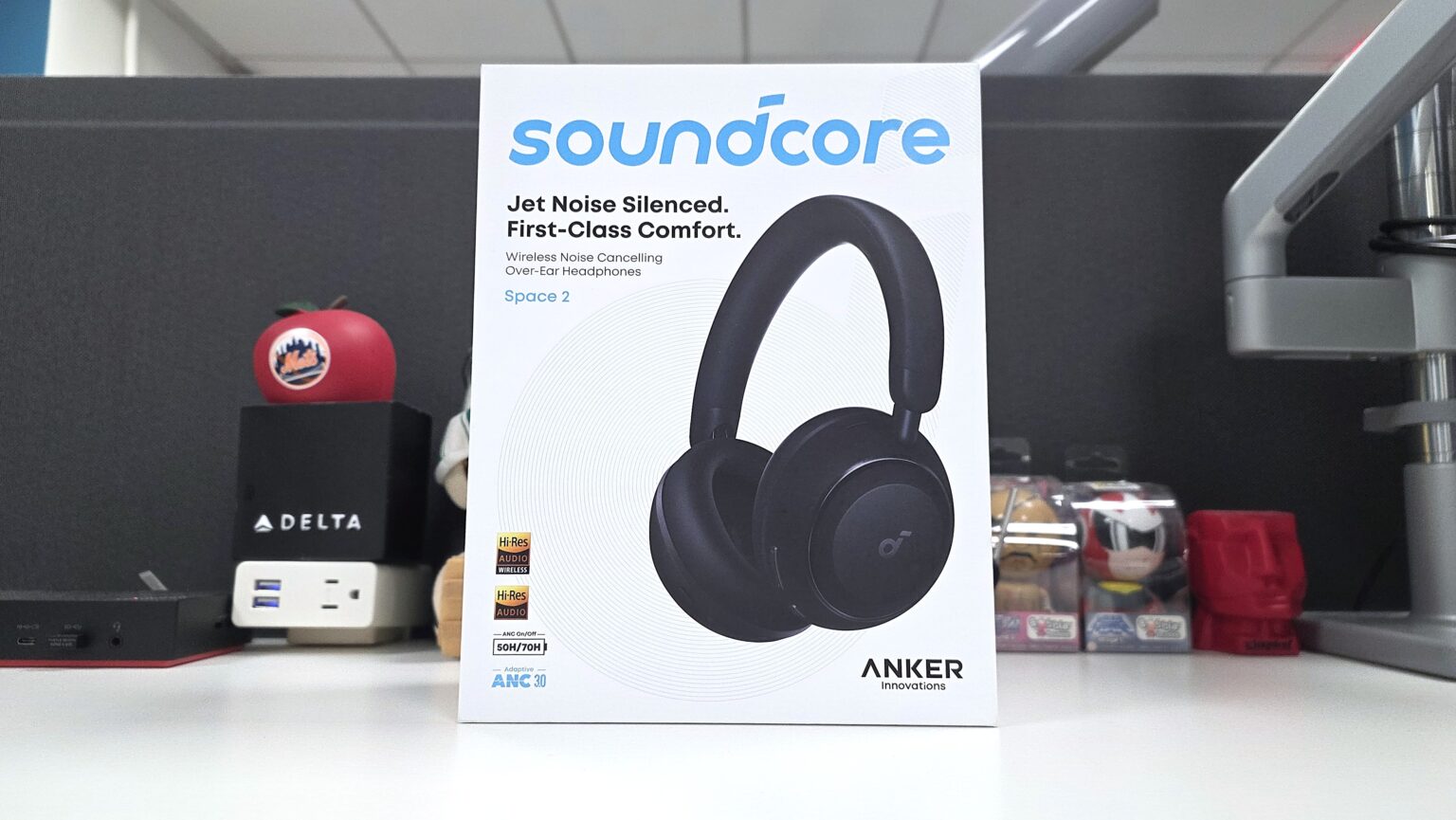
Following their announcement at the 2026 Mobile World Congress, today the Soundcore Space 2 headphones have officially launched. These headphones sport double-layer diaphragm drivers, 4-stage noise cancelation and up to a 50-hour battery life with ANC active. They also come with familiar features such as HearID, Smart Wearing Detection, and a three-mic array for facilitating clear calls. All of this comes at an approachable price point of $129.99.
We have spent some time with the new Soundcore Space 2 ourselves. So, let us dive into what exactly these headphones bring to the table.


The Soundcore Space 2 headphones are offered in three color options: Jet Black, Linen White, and Seafoam Green. They come with a charging cable, a carrying pouch, and a 3.5mm jack for wired use.
Build and Comfort


The Soundcore Space 2 headphones are driven by 40mm double-layer diaphragm drivers, designed for delivering crisp highs and a deep bass. This allows the headphones to produce High-Resolution audio and utilize the LDAC codec in both wired and wireless use scenarios. This performance is contained in a lightweight 264g frame, coupled with an ergonomic headband and protein leather ear cushions featuring slow-rebound memory foam.

One of the main components of the Space 2 is its 4-stage low-frequency noise cancelling system. Sound progresses through enhanced noise sensors, an upgraded processor, an optimized acoustic chamber and then the double-layer diaphragm drivers. What you get is an ANC implementation designed to tackle ambient noise with a focus on low-range sounds, such as the sounds from jet engines.
Each ear cup houses three microphones, where two of those mics are used for the headset’s 4-stage ANC. When on a call, all three microphones come into play to capture your voice clearly while continuing to filter out ambient noise. You then have a variety of additional features, such as wear-detection, a Nap Mode that plays white noise, transparency mode for hearing ambient sounds, and dual connectivity between two devices thanks to Bluetooth 6.1.


On the left ear cup, you have an NC button for toggling between listening modes, a power and Bluetooth pairing button, a USB-C port for charging and a 3.5mm jack for wired use. On the right, you have a play/pause button and a volume rocker button which can also be used for progressing through media tracks.
The Soundcore Space 2 sports a simple and clean build that is easy on the eyes. The flexible headband, soft leather ear cushions, and its 264g in weight all combine for a comfortable long-term wearing experience. The controls are simple and easy to manage, while offering some behavior customizability via the Soundcore app. You then toss in the optional 3.5mm cable which opens the headphones to more usage possibilities during air travel.
Not to be overlooked is the Soundcore Space 2’s impressive battery life. The headphones can give you an already impressive max of 50 hours of use with ANC active. However, you can stretch that up to 70 hours with ANC off. If you are in an energy pinch, the headset can get up to 4 hours of use from just a 5-minute charge. As the Space 2 supports LDAC, which transmits audio at a max bit rate of 990kbps, I had it enabled at all times with this headset. This transmission rate is about three times as much as the 328kbps from the default SBC codec. While this means a faster battery drain rate, I was still able to get a very respectable 30 to 40 hours of use from the Space 2 with both ANC and LDAC enabled.
Before even diving into the features available via the Soundcore app, the Soundcore Space 2 is a solid listening and traveling companion going off of its build alone.
Features and Performance

All of the various features and settings of the Soundcore Space 2 can be accessed using the free Soundcore app. The Soundcore app lets you change various options like listening modes, enabling LDAC or 3D Sound, or disabling the wear detection feature. Going further you can toggle through the many pre-loaded EQ’s, manually customize your own personal EQ, or have the headphones design an EQ for you using HearID.


As I mentioned with previous Soundcore headphones…
HearID is a Soundcore staple feature where you conduct a sound and hearing test. This allows the app to customize a personalized hearing experience for you. The app guides you through the procedure smoothly and leaves you with a “before and after” comparison screen when it is all done. While I did not stick with the HearID EQ that the app created for me, I did think that giving you a “before and after” confirmation prompt was a nice touch.
The headphones also come with Anka, an AI assistant that you can access straight from the headset. Outside of your day-to-day AI requests and questions, you can also use Anka for real time translation for over 100 languages.
Moving onto sound presentation and performance, I did the bulk of my listening with the Space 2 with the LDAC codec enabled. Whenever a headset has LDAC, I always turn it on to make sure I get the most detail possible from my sound. As such, here are my takes on the sound presentations from some of the notable EQ’s that are pre-loaded in the Soundcore app for the Space 2.


Signature Sound is the default sound presentation on the Space 2. It features a warm bass with clean percussion and good overall highs and mids. Vocals also come across quite clear. It is definitely a good default sound presentation that one could live with if they never cared to ever use the Soundcore app.
Bass Booster and Bass Reducer are each solid EQ’s that do exactly what their name suggests. What is good about each of these EQ’s is that they target the bass and lows directly without noticeably affecting the presentation of the other ranges. Bass Booster gives the bass a noticeable kick without feeling overbearing while Bass Reducer practically eliminates bass entirely in most cases.
Treble Booster and Treble Reducer also did their suggested jobs well, however they noticeably affected the presentation of other ranges. Treble Booster is pretty solid, giving you cleaner and crisper highs while noticeably taking some of the weight away from the lows. Treble Reducer significantly kills the highs leaving you with a somewhat lifeless presentation of mostly lows and mids. I am not sure who would want Treble Reducer, but it is there and it works for whatever it is worth.
Spoken Word is a subtly effective EQ, taking only a slight amount away from the Highs and Lows. When compared to the default Signature Sound EQ, you do not really seem to get more refined vocals, just slightly suppressed “everything else”. So, if you are trying to focus on vocals in your songs, this EQ will help with that. However, if you listen to podcasts, and I do listen to several, you will not get much more out of them using this EQ.
Acoustic, as it was with previous Soundcore headphones, became my preferred go-to EQ here. This EQ seems to simply enhance everything while taking nothing away. You have crisper percussion, clearer vocals, vibrant instrumentals and a warmer bass. It can come across as a somewhat louder or sharper EQ, so I can see why it is not the default setting compared to the more mellow Signature Sound. However, it is the sound presentation I appreciated the most from this headset.
Active Noise Cancelation (ANC) is quite solid with the Space 2. It is designed to focus on cancelling out the lows from airplane engines, trains and things of the like. However, it still does a good job at suppressing spoken word and various other unavoidable ambient sounds. In a vibrant noisy bar, it will not completely cancel out loud music and your occasional yellers. However, it will suppress those sounds well enough for you to still enjoy your media.
The Ambient Sound mode does a great job at letting you hear your surroundings while you listen to your media at any volume. Like ANC, it does its job quite well without affecting the overall sound presentation coming from the Space 2. However, I did find it odd that the Soundcore app did not give you options for adjusting the intensity of these features this time around. While I honestly find an adjustment feature to be handier for Ambient Sound than for ANC, it was odd to see it completely missing from the app. This does not necessarily hurt the performance of those features, but it would have been nice to have.
The 3D Sound mode is meant to simulate a spatial sound environment, adding to the immersion in your media. While this mode definitely adds that 3D soundscape feel to the playing media, it took a considerable amount away from the lows and bass in the sound when active. It also requires the deactivation of LDAC when used. As such, while it is nice to have, I preferred sticking with the LDAC-driven sound presentation that I used most of the time.
Call-handling on the Space 2 is superb. I went out of my way to hold conversations midday on busy New York City sidewalks. During those calls, my call participants told me that they could only hear me, and not the traffic or conversations of passers-by. Anker and Soundcore continue to improve on the call quality of their headphones, and it really showed here.
In the end, I was quite impressed with the overall performance of the Soundcore Space 2 headset.
Final Thoughts

The Soundcore Space 2 are a solid pair of noise cancelation headphones for their $129.99 price point. You have a quality sound presentation, effective ANC, and the basic assortment of settings that you would expect from any wireless headphones today. Their exceptional comfort and long-lasting battery then seals the deal on this cost-effective package.
If you are looking for an effective pair of headphones that get the job done without breaking the bank, then definitely look into the Space 2. You can check them out for yourself by clicking here.

† We were provided with a pair of Soundcore Space 2 headphonesfor review purposes and were not compensated for this review.