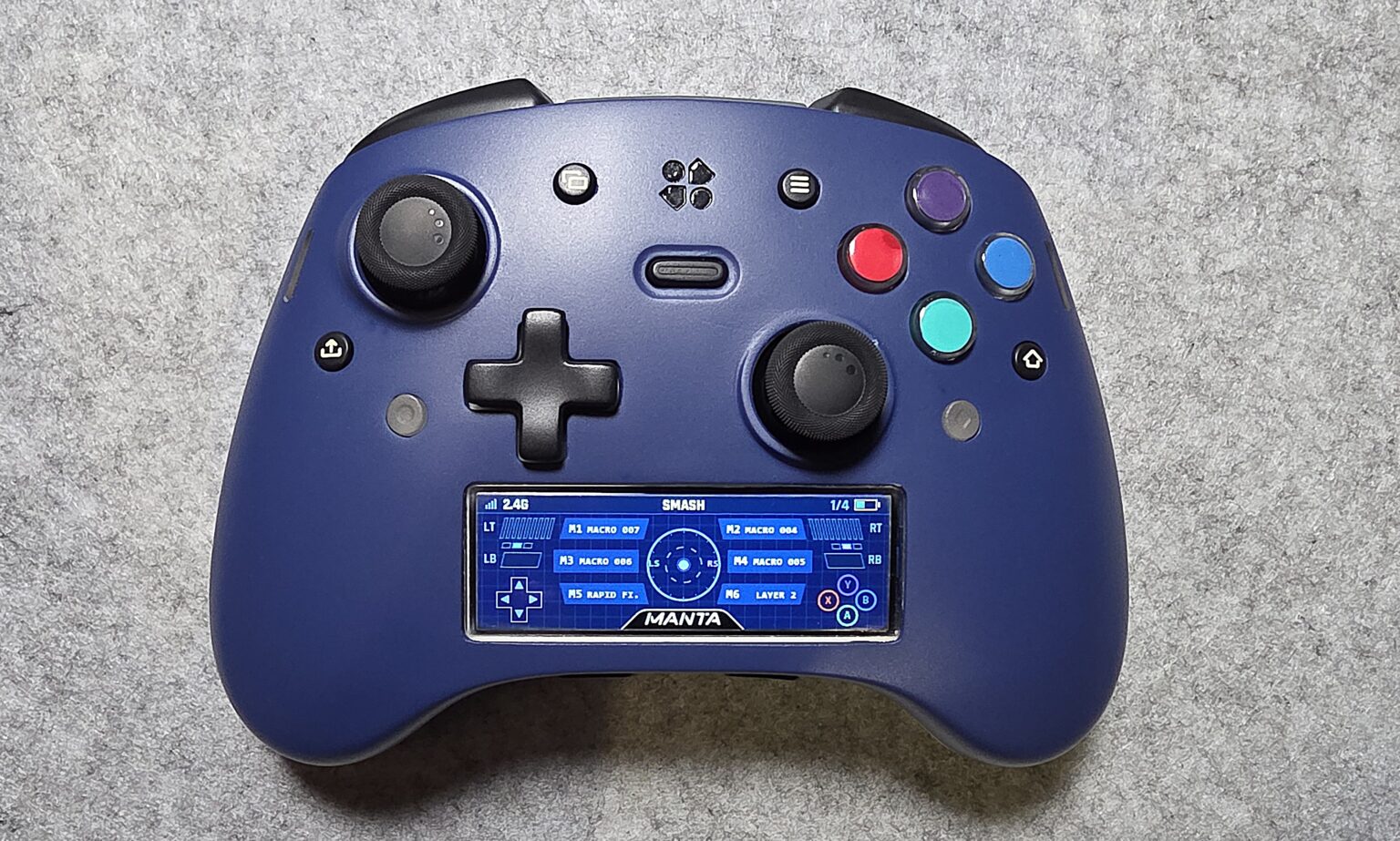
At Pax West 2026, Genki turned heads with their latest innovation on Kickstarter, the Genki Manta controller. The Genki Manta features analog face buttons, float-tension adjustable TMR thumb sticks, TriStage triggers, and onboard customization via a 2.79-inch display. Compatible with PC, mobile, and the Nintendo Switch 1 and 2, this controller is stuffed with a considerable amount of functionality across three connectivity options. So, we just had to check out the Genki Manta ourselves, with it sporting an already successful yet still ongoing kickstarter campaign.


At face value, the Genki Manta grabs your attention with its onboard display.


This display is powered by MantaOS, letting you control profiles, button tuning, connectivity, dashboards and custom apps straight from the controller.


You can also use the display to track macros, display key mappings or display other bits of info through its customizable dashboard. The controller also sports a KBM mode where you can use the controller and display to send keyboard and mouse inputs to your PC. If you are playing a PC game from your couch, and you need to handle a PC prompt or a private message, this solution keeps you functional without you having to leave your seat.


The display also lets you fully adjust your macros beyond simply recording a series of sequential inputs. Through MantaOS, you can fine-tune each input by the millisecond, allowing you to create perfectly timed macros straight from the controller. However, what if you happened to input a perfectly timed array of inputs during gameplay, and you wish you had been recording them beforehand? MantaOS has you covered with a feature that lets you revisit previous inputs to then record them into a macro retroactively. Going even further, the Genki Manta can store macros with a length of up to 5 minutes, with up to 4000 input events.

However, the Genki Manta is more than just a controller with a display screen gimmick. It sports an array of hardware features intended to combat those of any Pro controller out now. First, you have the Analog Pulse Buttons for the XYAB inputs. These buttons actuate on press, before the button bottoms out. Actuation then resets when the button begins to rise upward, even before topping out. This not only means faster face button inputs, but also faster rapid fire re-presses as well. Actuation and reset points are customizable via the onboard MantaOS software.
Next you have TriStage Hall Effect Triggers, which are split across three input modes. Digital gives you immediate hair trigger inputs with practically no travel, Rapid gives you a short travel analog input, and Analog gives you the full range of analog input usually preferred in racing games.
Then you have a feature that I personally have been waiting to return to today’s controllers for quite some time. Float-Tension Adjustable TMR thumb sticks allow you to control the tension of each thumb stick individually. Being a bit heavy handed myself, seeing this feature return in TMR thumb sticks is a godsend. You not only get the benefit of controlling the tightness of the sticks, but also the longevity that TMR contactless inputs provide. You can go even further by fine-tuning dead zones and sensitivity using MantaOS.
The Genki Manta also features Maglev Haptics for in-game feedback, as well as a gyroscope, accelerometer, and a compass for motion controls when in use with the Nintendo Switch. The controller supports wired connectivity with 8K polling, 2.4Ghz wireless connectivity with the included wireless dongle, and Bluetooth for connecting to the Nintendo Switch 1 and 2 as well as mobile.


There are additional controls outside of the standard array of buttons that you would see in an Xbox style controller. On the face of the controller, you have dedicated macro recording and KBM buttons. The Genki Manta sports additional mappable buttons near the bumpers and triggers. On the back you have two integrated rear buttons as well as two removable paddle buttons. You also have trigger adjustment switches and a cable eject button. The cable eject button is a nice touch for gamers like me that prefer to play wired at high polling rates. It is reassuring to know that accidental tugs at the wire will not take me out of the action during heavy gaming sessions. Lastly, on the bottom you have a mic mute button, a Manta Menu button, and a 3.5mm headphone jack.
Needless to say, I am excited for this controller’s release. I cannot wait to hopefully get my hands on it for a long-form review session. While it appears to be larger than many standard controllers out now, the controller still felt both light and comfortable. I would have been sold on the adjustable tension thumb sticks alone. However, this controller’s extreme level of features is bound to compete with any of the Pro-level controllers out now. If you are interested in checking out the Genki Manta or its Kickstarter campaign, you can do so by clicking here.